Design
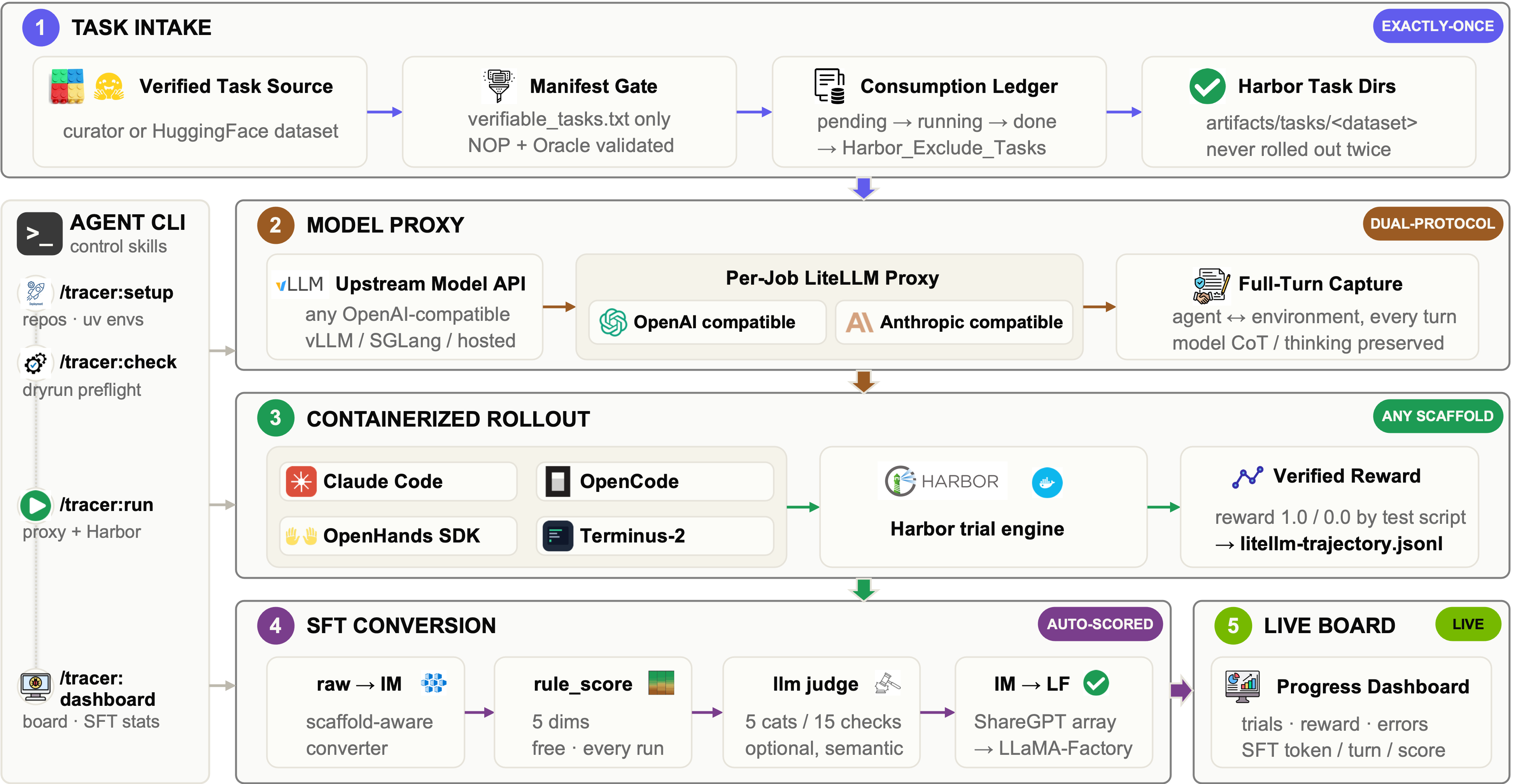
This page explains how Tracer turns verified tasks into trajectories and, when enabled, SFT-ready data. It follows the workflow in Overview: task intake, model proxy, containerized rollout, SFT conversion, and the live board.
Repositories
Tracer runs two pinned external repositories. scripts/update_repos.sh checks
each one out at the commit recorded in meta_info.repos in config.yaml, and
both checkouts are read-only: local edits are overwritten on the next update, so
changes belong upstream.
| Repository | Path | Role |
|---|---|---|
| harbor | repos/harbor | The rollout runtime. It builds each task's container, runs the agent inside it, applies the verifier, and writes the trial directory. It also supplies the trajectory logger the LiteLLM proxy loads. |
| swe_data_process | repos/swe_data_process | The trajectory converters. One module per scaffold turns raw rollouts into IM records and then LLaMA-Factory LF data, and computes the TQS quality scores. |
1. Task Intake
Tracer starts from a verified task source. In config.yaml, this is controlled
by runtime_info.input.task_source:
local: read Curator output, usually../curator/artifacts/merged_swe_tasks.huggingface: download a compatible task dataset snapshot.
The intake logic lives in scripts/prepare_tasks.sh. It stages Harbor task
directories under:
artifacts/tasks/<dataset>/For local Curator output, Tracer looks for verifiable_tasks.txt. If the
manifest exists, only listed task IDs are staged. If it is missing, Tracer
stages every valid Harbor task directory. This is the manifest gate in the
diagram: verified Curator tasks get through; unfinished or failed task
candidates stay out.
A local source is staged by linking, not copying: the dataset directory is real, and holds one symlink per task id pointing back at Curator's pool. Nothing is duplicated on disk, and a staged batch never drifts from the pool Curator keeps writing to. Linking per task rather than linking the pool as a whole is what lets the manifest gate above still apply. A Hugging Face source is copied out of its downloaded snapshot instead.
Tracer also keeps a consumption ledger:
artifacts/processed_tasks.yamlBefore a new run, scripts/start.sh calls scripts/resolve_exclude_tasks.py to
turn this ledger, plus HARBOR_EXCLUDE_TASKS, into Harbor
--exclude-task-name flags. That gives Tracer exactly-once behavior for normal
runs: completed or retired tasks are not rolled out again by accident.
2. Model Proxy
Tracer never points an agent at the upstream model API. Every run starts its own
LiteLLM proxy, rendered by scripts/start.sh from runtime_info.input.llm_api
and runtime_info.input.litellm_proxy into:
artifacts/litellm/<job>/litellm_config_tracer.yamlThe agent container only ever sees the proxy:
ANTHROPIC_BASE_URL=http://<host>:<proxy-port>
ANTHROPIC_API_KEY=<litellm master key>
ANTHROPIC_MODEL=<configured model>
That indirection is the load-bearing design decision in this block, and it buys four things at once.
One capture point. The proxy sits below the agent, so every model call is recorded without patching the agent or trusting it to write its own log. An agent that crashes mid-run still leaves behind every turn it managed to make.
One protocol surface. The generated config sets
use_chat_completions_url_for_anthropic_messages: true, so an Anthropic-style
agent (Claude Code) and an OpenAI-style agent (OpenCode, OpenHands SDK) both
reach the same upstream chat-completions endpoint. drop_params: true lets a
scaffold send parameters the upstream does not accept without failing the call.
This is why swapping scaffolds does not mean swapping model providers.
Per-job isolation. The config, the master key and the copied logger all live
under that job's directory, so two jobs never share proxy state. Token costs from
llm_api are attached to the model entry, which is what makes per-run spend
visible; LiteLLM's own spend logs are disabled since the trajectory records
already carry usage.
Cache-friendly routing. The logger derives a sticky routing key from each task's trajectory path, so all turns of one task keep landing on the same upstream deployment. Long agent rollouts repeat a growing prefix on every turn, and prefix caching only pays off if the turns stay together.
How a turn becomes a record
scripts/start.sh copies trajectory_logger.py out of the pinned Harbor
checkout and registers it as a LiteLLM callback
(callbacks: trajectory_logger.trajectory_logger). On every completed call, and
on failures too, it writes one JSON line containing:
| Field | What it holds |
|---|---|
session_id | The task instance the call belongs to. |
request_body | messages, tools, model, max_tokens, top_p, temperature. |
response_body | choices[].message with content, reasoning_content and tool_calls. |
usage | Prompt and completion tokens, plus the computed cost. |
success, duration_ms, timestamp | Outcome and timing; a failed call adds a failure block instead of a silent gap. |
The important part is that the logger normalizes into OpenAI chat-completions shape before writing. Anthropic-format traffic is rewritten into the same record layout as OpenAI traffic, so the raw capture does not remember which protocol the agent spoke.
Where the line lands is decided per request, through the
x-trajectory-output-path header (or the equivalent request metadata) that
Harbor attaches. Tracer sets that pattern to:
artifacts/jobs/<job>/<task>/agent/litellm-trajectory.jsonlSo a single shared proxy still produces one clean, per-task trajectory file, with no post-hoc demultiplexing.
3. Containerized Rollout
After the proxy is ready, scripts/start.sh builds the Harbor command from
runtime_info.input.harbor_job and runtime_info.input.agent.
The generated command is effectively:
uv run harbor run \
  --path artifacts/tasks/<dataset> \
  --jobs-dir artifacts/jobs \
  --agent-import-path <agent class> \
  --job-name <dataset-agent-version-model-timestamp> \
  --model <model> \
  --n-concurrent <N> \
  --timeout-multiplier <factor> \
  --max-retries <N>
The agent runtime is mounted into each task container. For the default
custom-claude-code scaffold, Tracer derives the agent import path and
Anthropic protocol automatically. For other scaffolds, the config must keep the
agent name, import path, protocol, version, runtime image, runtime mount, and
SFT conversion scaffold aligned.
The current pinned runtime versions are Claude Code 2.1.118, OpenCode
1.18.7, and OpenHands SDK 1.33.0. These version numbers should match the
runtime image tag and the conversion scaffold used for the job.
Each task produces a Harbor trial directory:
artifacts/jobs/<job>/<task>/
├── result.json
└── agent/
    └── litellm-trajectory.jsonl
result.json records the verified reward, and litellm-trajectory.jsonl
contains the full turn-by-turn model and agent trace.
4. SFT Conversion
SFT conversion is optional. It runs automatically after Harbor only when
runtime_info.input.sft_conversion.enabled is true, or manually through:
bash scripts/convert_trajectories.sh --job <job>The proxy gave every scaffold the same record shape, but not the same record
meaning. How an agent frames a system prompt, represents a tool call, or splits
work across sub-agent turns is still its own convention. Conversion is where that
difference is resolved: scripts/convert_trajectories.sh picks a converter per
scaffold, derived from agent.name unless sft_conversion.scaffold names one
explicitly.
| Scaffold | Converter module |
|---|---|
claude_code | swe_data_process.claudecode_opencode.convert_cc_to_im |
open_code | swe_data_process.claudecode_opencode.convert_oc_to_im |
openhands_sdk | swe_data_process.openhands.convert_openhands_sdk_to_im |
terminus2 | swe_data_process.terminus2.convert_terminus2_to_im |
Every converter emits the same IM record, so scaffold-specific handling stops at
this boundary and one LF writer serves all of them. Two filters run here rather
than at training time, because they are judgements about the rollout: only
resolved instances (reward 1.0) are converted at all, and for the converters
that support it, turns are screened for reasoning content, adaptively and against
a ratio threshold. A rollout that passed its tests but reasoned in one-line
stubs is not the same training signal as one that worked the problem.
The output lands under:
artifacts/sft_data/<job>/
├── im.jsonl
├── lf.json
├── lf.stats.json
└── .convert_sig.json
im.jsonl keeps intermediate records and quality facts. lf.json is the
LLaMA-Factory ShareGPT-style file Trainer can consume directly.
5. Live Board
The dashboard reads Tracer artifacts rather than a separate database. Its main inputs are:
artifacts/index.yaml
artifacts/jobs/<job>/result.json
artifacts/jobs/<job>/<task>/agent/litellm-trajectory.jsonl
artifacts/sft_data/<job>/lf.stats.json
artifacts/sft_data/<job>/im.jsonl
That is why dashboard refreshes can be cheap: the board scans the files Tracer already writes, then renders job status, rewards, errors, trajectories, and SFT conversion statistics.
For the shortest runnable path, see Getting Started. For the exact files written by each stage, see Output Format.