Motivation
Long-horizon, high-quality agentic code data is becoming central to pushing the capabilities of modern LLMs. However, building a good coding-agent data pipeline is non-trivial in practice. Taking software-engineering data as an example, the pipeline involves multiple stages: mining real repositories, collecting valid PRs, creating verified tasks with runnable environments, rolling out and filtering successful trajectories, and closing the training-evaluation loop.
LegoFlow aims to simplify the whole process of code data engineering by turning the whole agentic-data pipeline into a set of reusable, inspectable blocks. Each block has a clear contract, standard plugin skills, its own dashboard, and archived artifacts, so users can run the pipeline stage by stage without memorizing hidden handoffs. The same structure also keeps the system extensible: new data domains, new coding agents, new training recipes, and new evaluation rubrics can be added while preserving a consistent way to configure, run, debug, and compare results.
Blocks as Workflow Contracts
LegoFlow is built upon blocks, a structured way to define how agent workflows proceed and interact with each other.
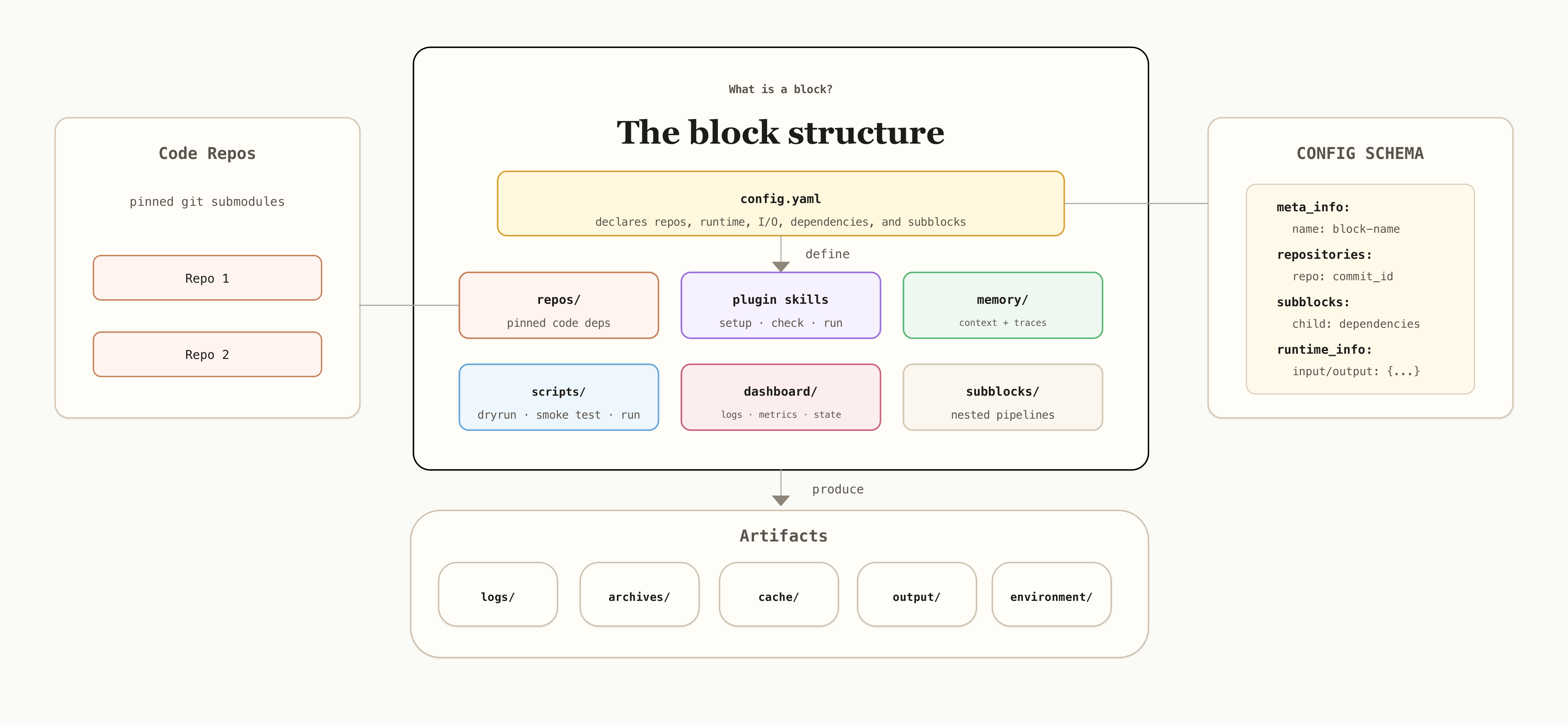
A block is one runnable unit in the pipeline. It owns one stage of work, such as task curation, trajectory rollout, training, or evaluation, and packages that stage so a person and an agent can operate it in the same way.
Each block follows the same contract:
config.yamldeclares the block identity, runtime inputs, published outputs, remote machine settings, pinned repositories, and dependency edges;CLAUDE.mdexplains the operating contract for the agent working inside the block;.claude/plugins/exposes the block through predictable skills such as setup, check, run, and dashboard;scripts/contains the executable workflow;repos/pins the implementation code that the block runs but does not own;artifacts/stores outputs, logs, environments, and archived runs;dashboard/reads artifacts and makes the block's state visible.
This structure turns an informal pipeline into a set of explicit contracts. A block states what it consumes, what it produces, how it should be run, where it runs, and how its outputs are handed to neighboring blocks.
Note that a block can run on any accessible cluster, local machine, or remote server that satisfies its environment requirements. This allows easy collaboration between different workflows. For the full anatomy, see What is a Block.
Easy Expansion
The block design makes LegoFlow easier to extend because new workflow stages can be added without rewriting the whole pipeline. A new block only needs to obey the same contract: declare its inputs and outputs, expose standard plugin skills, write artifacts under its own directory, and document how it connects to neighboring blocks.
This gives developers a clean boundary. Workflow changes, such as new skills,
new checks, new dashboards, or new handoff fields, live in the block. Domain
implementation changes, such as a new task generator, converter, training
method, or benchmark adapter, live in the pinned repository under repos/.
Because the boundary is explicit, LegoFlow can grow from SWE data to other
long-horizon agent-data domains without forcing every stage to share the same
codebase or runtime.
(Recursive) Self-improvement
LegoFlow thus has the potential for (recursive) self-improvement by concatenating the workflows of multiple blocks. Given a particular objective, the root block can orchestrate its subblocks: Curator creates tasks, Tracer collects successful trajectories, Trainer turns those trajectories into a new checkpoint, and Evaluator measures whether the checkpoint actually improves.
In other words, LegoFlow can repeatedly collect tasks, generate trajectories, train, and evaluate in one connected loop. A concrete end-to-end example is described in this temporary blog post.
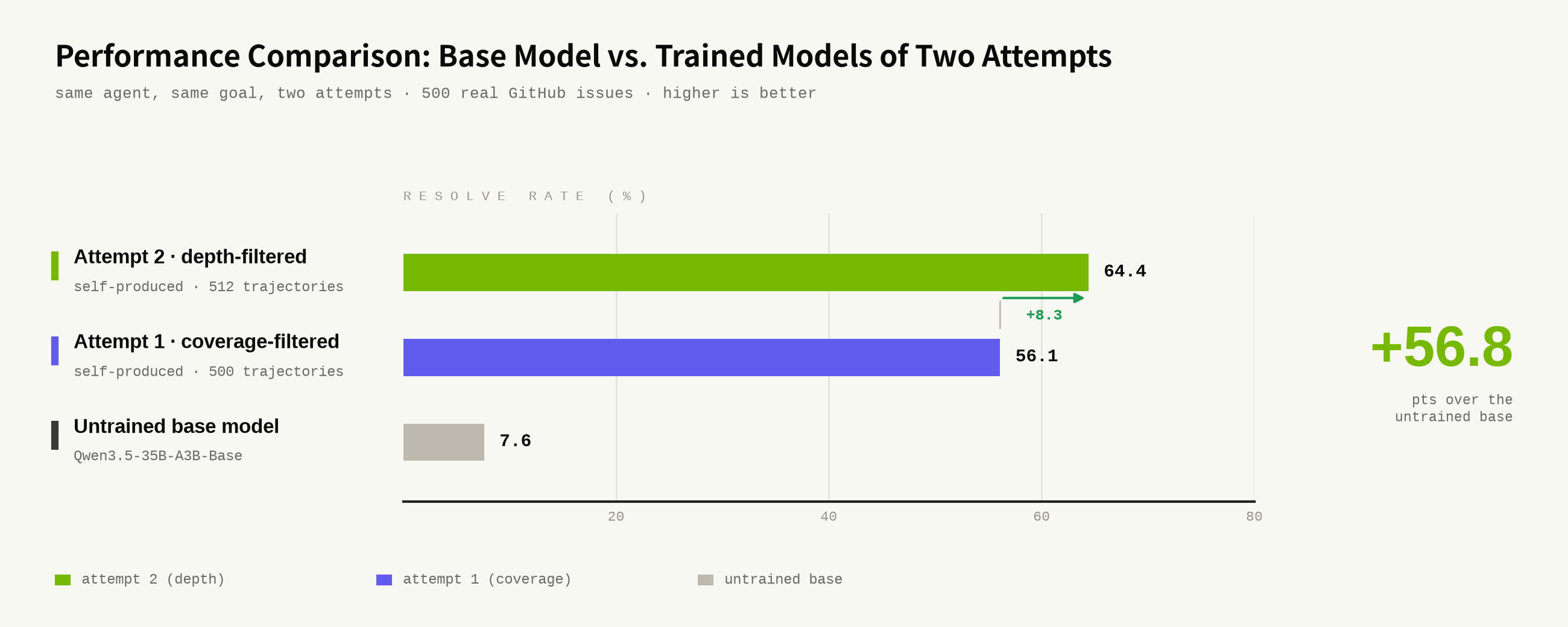
The same loop can also be used to tune block-level choices, such as task filters, rollout agents, trajectory selection rules, training settings, and evaluation suites, then compare the resulting artifacts across runs.