What is a Block
A block is the unit of work in LegoFlow. One block owns one stage of a pipeline and is packaged so that a person and an agent can operate it the same way.
Nothing in this definition is specific to the four blocks that ship with LegoFlow, and nothing is specific to the root. A block is a general shape; the root block is simply the block at the top of the tree, obeying the same contract as everything under it.
1. The Shape of a Block
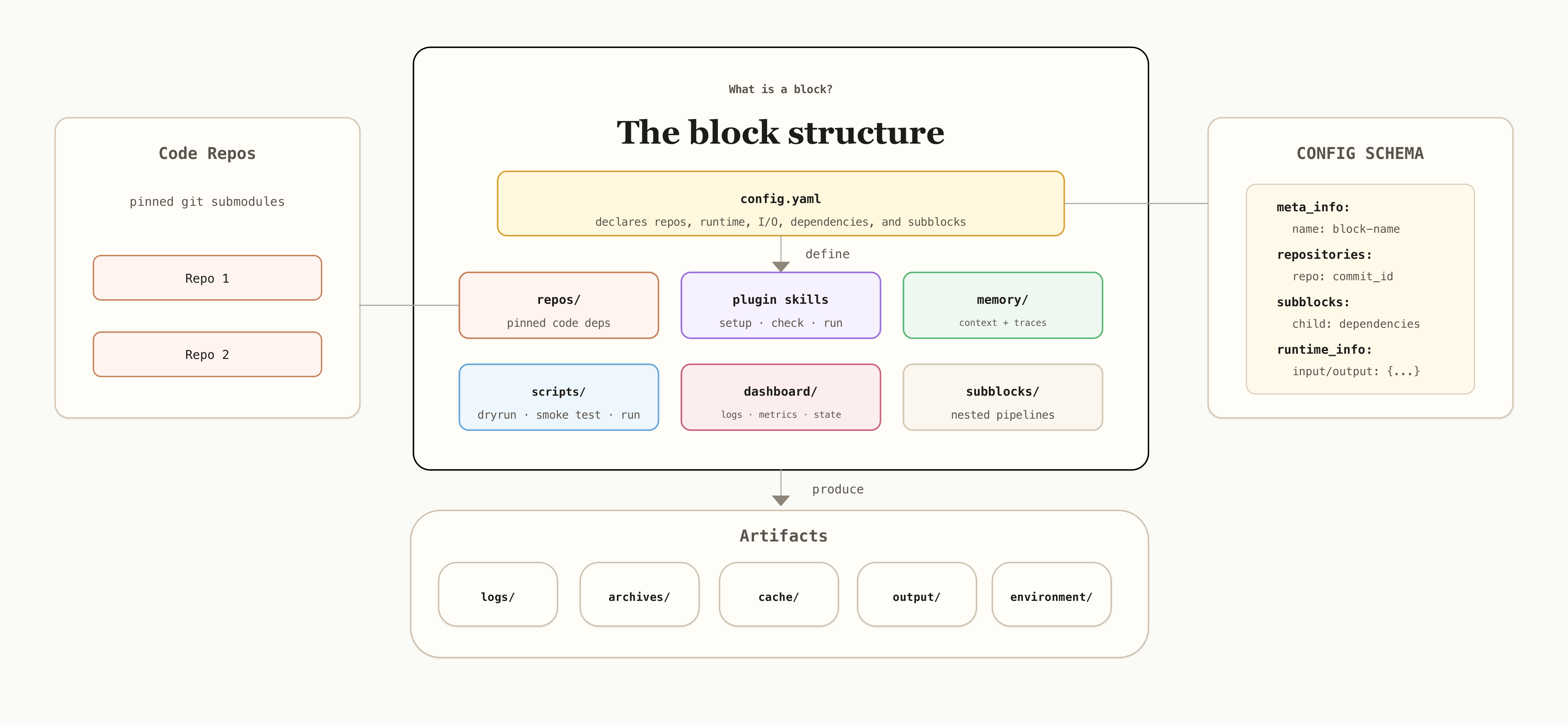
Three ideas hold the shape together.
Declaration comes before execution. config.yaml is the declaration layer:
it names the block, pins the code it runs, states which upstream outputs it
consumes and which downstream inputs its own outputs feed, and separates the
values that come from outside from the values the block publishes. Every script,
skill and check reads that declaration rather than rediscovering the facts.
A run stays inside the block. Pinned dependencies live in repos/,
executables in scripts/, and everything a run produces in artifacts/. You can
delete a block's artifacts/ and lose nothing but that block's history.
The shape nests. A block may contain child blocks under blocks/. A leaf
block does work; a parent block coordinates children and does no work of its
own. Because parent and child obey the same contract, a pipeline can grow a level
without any new concepts.
2. What is Inside a Block
| Part | What it means |
|---|---|
config.yaml | The declaration: identity, where the block runs, pinned repositories, dependency edges, runtime inputs and outputs. |
CLAUDE.md | The agent contract. What this block is for, what it consumes and publishes, how it is run, and what must not be touched. |
scripts/ | The executable surface: start.sh to run, dryrun.sh to validate without side effects, clean.sh to reclaim space, stop.sh to terminate. |
repos/ | Vendored code the block runs but does not own, pinned to a commit. |
artifacts/ | Everything a run produces: outputs, logs, environments, caches, and the archive of each run. |
dashboard/ | Reads artifacts/ and renders the state of the block. It never mutates anything. |
memory/ | Long-form context for the agent operating the block: decisions, observations, postmortems. |
blocks/ | Child blocks, if this block has any. |
.claude/plugins/ | The block's operational interface, exposed as slash commands. |
The rest of this section explains the parts whose meaning is not obvious from the name.
Inputs are external, outputs are published
runtime_info.input holds only values that originate outside the block tree:
API keys, tokens, model names, human decisions. Those are the values you fill in
by hand. Fill markers are standardized: human means the run is blocked until you
replace it, "" means the value is derived at runtime or supplied through an
environment channel, and null means an intentional unset.
runtime_info.output holds what the block publishes for others to consume. An
output has a path fixed at authoring time, a value written back by the run, or
both. Never copy an upstream block's output into your inputs by hand; declare the
dependency instead.
Dependencies are declared from both ends
meta_info.dependencies has two keys. The consumer writes from: the key is the
dot-path in its own runtime_info.input that receives the value, and the value
names <source_block>.output.<key>. The producer writes the mirror image in
to. The same edge therefore appears in two files, and
scripts/validate_config.py cross-checks them at preflight.
Declaring an edge twice looks redundant until a block is read on its own. Each block's file then answers both questions a reader has, where its inputs come from and where its outputs go, without opening the rest of the tree.
The config is one-shot; live state lives elsewhere
config.yaml is configuration read at launch, and nothing else. Whether a run is
in flight, completed or failed is not recorded there. That belongs to
artifacts/index.yaml, whose newest entry is the live state, written
automatically when a run exits.
Keeping the two apart is what makes a config safe to read, diff and archive: it describes an intent, not a status.
Pinned code is read-only
Everything under repos/ is pinned to a commit, and the operating agent must not
edit it. The pin is what makes a run reproducible, and it is recorded in each
archive. A silent local edit breaks that contract without leaving a trace, so a
fix belongs upstream, or in scripts/ and config.yaml.
Where a block runs
meta_info.resources.ip decides execution location. local, null or absent
means the current host. A real address means the operating agent connects to that
node and runs there, inside a persistent session, using
meta_info.resources.directory as the working directory.
Every run leaves an archive
A run writes artifacts/archives/run_NNN/: the config as it was, the scripts as
they were, the repository commits, and a metadata.yaml with timestamps and exit
code. This is installed as an exit trap, so an interrupted or failed run is
archived exactly like a successful one. A timeline with holes in it would be
worse than no timeline.
3. The Block Plugins
Every block ships a Claude Code plugin at .claude/plugins/<block>-plugin/,
and a Codex plugin at plugins/<block>/. The Codex skills are thin wrappers
that read and follow the canonical Claude Code skill files rather than copying
their workflow logic.
| Lifecycle | Claude Code | Codex | Purpose |
|---|---|---|---|
| Setup | /<block>:setup | $<block>-setup | Bring the block from a fresh clone to a state where check passes: install environments, sync pinned repos, fill in unset inputs. Idempotent. |
| Check | /<block>:check | $<block>-check | Read-only preflight: schema, inputs, repo pins, environments, reachability of endpoints and hosts. Reports every failure at once. Mandatory before a run. |
| Run | /<block>:run | $<block>-run | Preflight, confirm, then execute. At a leaf block this runs scripts/start.sh; at a parent block it dispatches to each child's own run skill in dependency order. |
| Dashboard | /<block>:dashboard | $<block>-dashboard | Surface the block's state, as a summary and optionally a web board. Read-only. |
The uniformity is the point. Learning one block is most of the work of learning the next, and an agent can operate a block it has never seen from the same four verbs. A parent block calls its children's skills rather than reaching into their scripts, so the recursion happens through the same interface a human would use.
Two deliberate exceptions:
- Termination is not a skill.
scripts/stop.shdoes the signal handling directly, because stopping a run should not depend on an agent being available to interpret a request. - Root creation exists only at the root. Use
/root:createin Claude Code or$root-createin Codex. Creating a block mutates the tree, and that authority is not delegated to blocks inside it. See Adding New Blocks for the development workflow.