Design
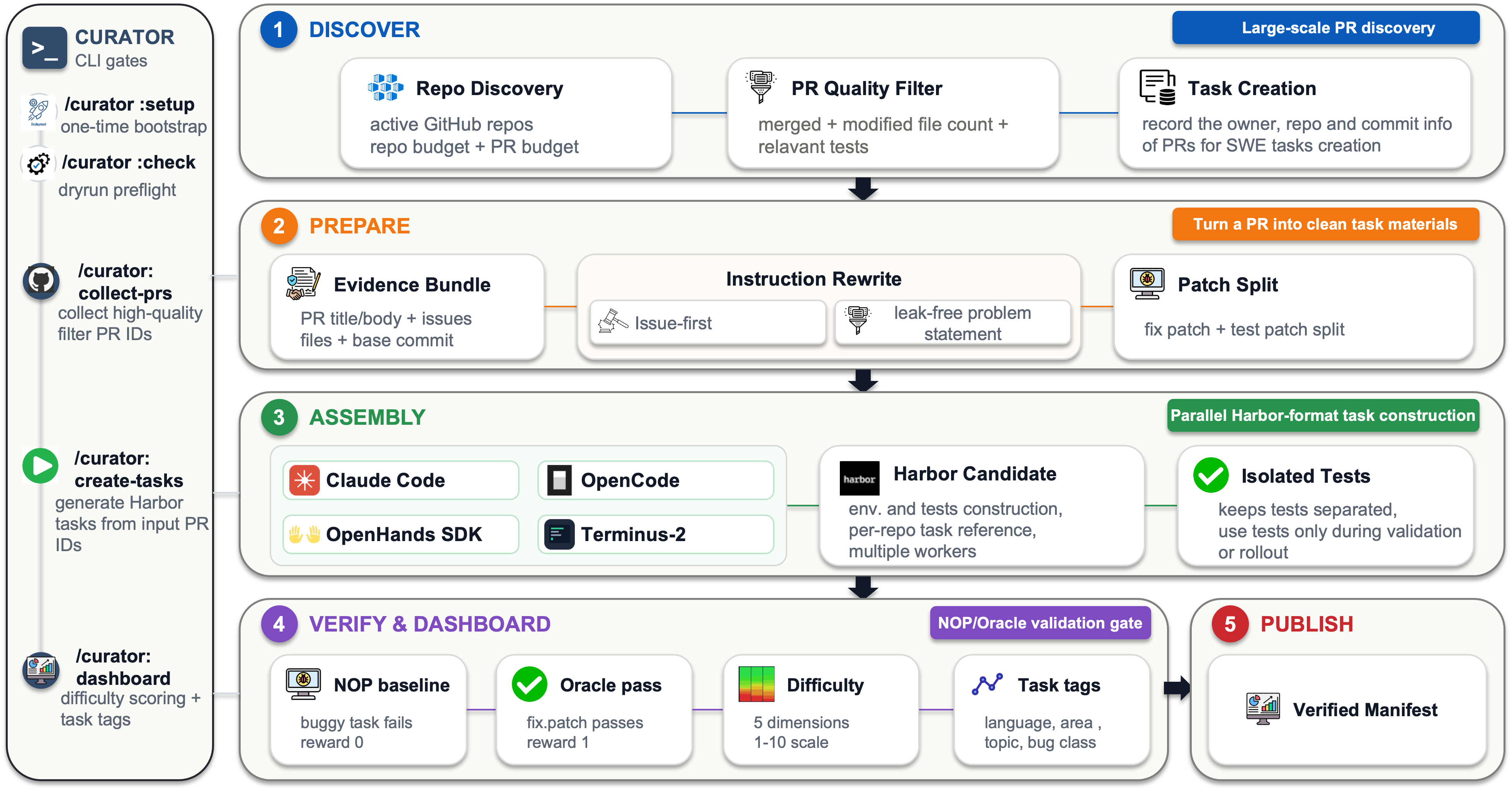
Curator's problem is not finding code changes. GitHub has an unlimited supply of those. The problem is turning a merged pull request, which is a record of what somebody already did, into a task that can be given to an agent and then judged automatically. Everything below follows from that: a task is only useful if a solver cannot see the answer, and only trustworthy if a machine can decide whether the answer was reached.
Repositories
Curator runs one pinned external repository. /curator:setup checks it out at
the commit recorded in meta_info.repos in config.yaml, and the checkout is
treated as read-only: local edits are overwritten on the next update, so changes
belong upstream.
| Repository | Path | Role |
|---|---|---|
| legoflow-curator | repos/legoflow-curator | The legoflow-curator CLI and its tools: PR collection, task generation through the Claude Code path, NOP/Oracle validation, and difficulty scoring. |
1. Selection is a Filter, Not a Crawl
The goal is explicitly not to collect every PR. Selection runs as three stages, each narrowing the set before the next one spends more to look closer: repositories, then pull requests inside them, then the tasks those PRs can actually become. The ordering is the whole point. Stage one costs a few GitHub search queries, stage two costs one metadata fetch per PR, and stage three costs a container build plus two verification runs per candidate. Putting the cheap filters first is what keeps a language sweep affordable.
Stage 1: repositories
Search is repository-first, driven by pr_collection.filters in config.yaml:
| Filter | What it is really asking |
|---|---|
min_stars, min_merged_prs | Does this project have review discipline? Both are proxies for merged changes being real, reviewed fixes rather than drive-by commits. |
min_language_percentage | Is the target language actually this codebase's language? In a repo where it is a minority, the container ends up building a toolchain for code the task never touches, and failures turn into build problems rather than code problems. |
max_days_since_push | Is the project still alive? An abandoned repo pins dependencies that no longer resolve, so its tasks fail at image build time, sometimes long after collection. |
repo_num caps how many qualifying repositories are kept per language.
Stage 2: pull requests
Inside each surviving repository, at most max_prs_per_repo candidates are kept,
filtered again:
| Filter | What it is really asking |
|---|---|
min_issue_body_length | Is there a stated problem to work from? The linked issue is the raw material for instruction.md; without one there is nothing to write a task from except the diff, which is the answer. |
min_files_changed, max_files_changed, max_lines_changed | Is the change one coherent unit of work? Below the floor, the fix is a one-liner and the task is ambiguous. Above the ceiling, the PR has bundled a refactor with the fix and the tests no longer isolate a single behavior. |
Some languages cannot meet the global thresholds. The collector therefore keeps a
per-language override table that takes precedence over these values (C, for
instance, runs with lower star and merged-PR floors and a wider file budget).
Those overrides live in the collector rather than in config.yaml, on the view
that they are properties of the ecosystem, not knobs for a run.
The output is one candidate list per language:
artifacts/collected_prs/
├── python_pr_ids.txt
├── javascript_pr_ids.txt
└── ...
Stage 3: tasks
Generation applies the last filter, because some things can only be judged once
the PR is opened up. --min-source-files and --max-source-files set the
yield-versus-difficulty dial: a floor of 1 keeps the most PRs, including small
fixes, and the shipped per-language scripts use 2 to drop single-file trivia.
--no-require-issue relaxes the linked-issue requirement when a language's pool
is too thin without it.
Whatever survives here is still only a candidate. Nothing counts as a task until the two baselines in section 3 agree.
2. The Visibility Boundary
Each surviving candidate becomes a Harbor task directory:
artifacts/swe_tasks/py-cc/<task_id>/
├── task.toml
├── instruction.md
├── environment/
│   ├── Dockerfile
│   └── bug.patch
├── solution/
│   ├── fix.patch
│   └── solve.sh
└── tests/
    └── test.sh
The layout encodes the single rule the whole dataset depends on: instruction.md
is what a future agent reads, and solution/ and tests/ exist only for
verification. Generation is asked to state the problem without describing the
patch, because the reference fix reaching the prompt does not produce a wrong
score, it produces a convincing one. That kind of leak is invisible in the
resulting numbers, which is why it is enforced by structure rather than by
review.
3. Two Baselines Decide What Counts as Verifiable
A task directory existing proves nothing. During generation, Harbor runs two baseline agents against every candidate:
- NOP baseline: change nothing. The tests must fail, reward
0. - Oracle pass: apply the ground-truth fix. The tests must pass, reward
1.
Both bounds are needed, and each one rules out a different failure. Without the NOP run, a task whose tests already pass would be accepted and would be scored as solved by an agent that did nothing. Without the Oracle run, a task whose tests can never pass, because the environment is broken or the fix is incomplete, would be accepted and would be scored as failed no matter how good the agent is. Only candidates that fail before and pass after are appended to:
artifacts/swe_tasks/<lang>-cc/verifiable_tasks.txtDifficulty and the semantic tags are computed here too and written back into each
task's own task.toml, so the metadata travels with the task rather than living
in a side index that can drift.
4. The Manifest is the Contract
verifiable_tasks.txt is the only authoritative statement of what Curator
produced. The task directory tree is not: it also holds candidates that are
half-generated, failed validation, or are still being written by a running worker.
This is why downstream blocks filter through the manifest instead of scanning directories. Tracer's staging step reads it and links only the listed ids, which is what lets Curator keep generating into the same pool while Tracer is already rolling out against it.
The merged pool at artifacts/merged_swe_tasks/ is the same contract in
materialized form, built by an aggregator that runs alongside generation, so the
downstream side always has one directory to point at.
For the shortest runnable path, see Getting Started. For the exact files written by each stage, see Output Format.